
A GIANT question
Mark Rosenblatt's play about Roald Dahl's antisemitism reflects both internal Jewish struggles and the historical tropes that are being repeated by non-Jews in our current moment.

“If it happened here, where would you go?”
Growing up Jewish in the 60’s and 70’s one didn’t have to name “it”, because it permeated the air we breathed. Tattooed survivors of Nazi concentration camps lived among us. The underlying antisemitism, which allowed ordinary Germans to look the other way still lived among us, too.
In primary school in the UK I was told that I personally, was responsible for killing Jesus.
In middle school in Stamford, CT, classmates they threw pennies on the ground for us to pick up because we were avaricious Jews.
As for the question of where we would go, there was only one answer. The place that had been created as a result of “it”. The place that had to exist so that we had an exit plan in case “it” happened again. The place we were raised to think was the “land of Milk and Honey.” The place for which we brought a quarter to Hebrew School to put in our blue JNF folders, which when filled would plant a tree there.
As kids we didn’t realize the political nature of planting those trees, or that our quarters were being used to plant fast-growing non-native species, which had ecological consequences. 1
As antisemitism rises across the world, from the right, and in the last few years, increasingly from the left (people we previously considered friends and allies,) the “where would you go ” question has been a painful private conversation I’ve had with many progressive Jewish friends.
Personally, I don’t know anymore, because the answer I was taught as a child no longer works.
This was all very much on my mind last week when I ventured into New York to catch GIANT by Mark Rosenblatt. The play garnered three Olivier Awards during its UK run, and last week earned a Tony for John Lithgow, who plays the late author Roald Dahl.
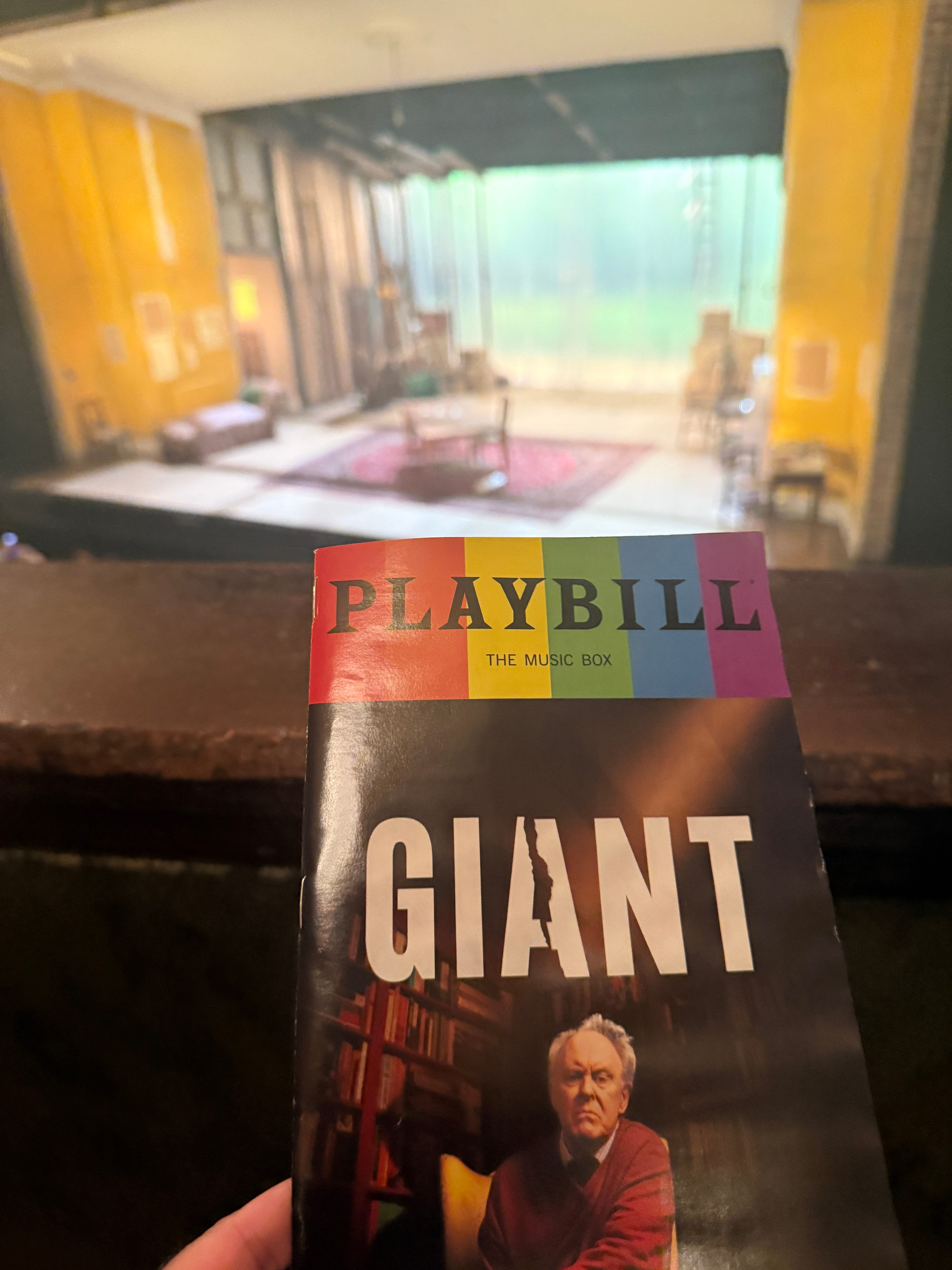
GIANT depicts imaginary discussions that take place over one afternoon in 1983, after Dahl wrote a review of God Cried, by Tony Clifton and Catherine LeRoy for The Literary Review. The book covered the siege of west Beirut in 1982 and the subsequent massacres at Sabra and the Shatila refugee camp. Dahl brought to the review both his righteous anger at the murder of innocent civilians, and his existing, virulent antisemitism.
And no, it wasn’t “just anti-Zionism.”
The review compared the State of Israel to Nazi Germany. But where Dahl really showed his antisemitic spots — and why this play is, unfortunately, so timely is that he cast collective blame for the Lebanon war to all Jews in the Diaspora. He engaged in the usual Schrodinger’s Jew characterization of declaring the Jewish people both all powerful, in control of the media and the banks, yet at the same time weak and cowardly.
Why write a play about an event that happened forty years ago, and why now? According to a review in The Times:
Rosenblatt, a 47-year-old theatre director turned playwright, had been casting around for a way to explore criticism of Israel, racism against Jews and the conflation of the two. In Dahl’s book review….he found the perfect “mirror” to reflect the same arguments that are raging round Israel’s response to the Hamas terrorist attacks of October 7. “I thought, what if our way into this story was through someone that we know and love, and have an affectionate relationship with?”2
Most of the dialogue is imagined, but the audience is reminded in a note from the playwright in the program, Rosenblatt uses some actual Dahl quotes at critical junctures, to allow the audience to make up their own mind.
“What I wanted to do was write something that was both nuanced and even-handed about the issues around Israel and Palestine, and also about the difference between meaningful discourse around that and antisemitic stereotyping. Also, just on a human level, [I wanted to] try to find what was both incredibly generous and subtle and heartfelt about him as a man — but also where his cruelty lay, and how and why it was difficult for people to operate around him.3
The play opens as Dahl and his UK agent, Tom Maschler, review Quentin Blake’s illustrations for Dahl’s forthcoming book, The Witches. Dahl is cantankerous and petulant, but also mercurial, suddenly oozing charm and humor, particularly in the presence of his long-time mistress and current fiancee, Felicity Crosland.
Jessie Stone, a fictional character from his US publishers, FSG, arrives to persuade Dahl to issue an apology for his remarks. Dahl toys with her like a cat tormenting a mouse, asking her if she is Jewish and if her surname was Stein before they changed it. She and Maschler are both Jewish, but their approach to antisemitism is different.
After attempting to be professional and unemotional, Stone finally explodes, asking:
“What would your government do if militants constitutionally committed to wiping Britain off the map started firing rockets into Kent from the French coast? For ten days? Serve tea and scones?”
ROALD: They wouldn’t lay waste a city!
JESSIE. Dresden, Nagasaki?
ROALD. How dare you compare them?!
JESSIE. Why, because you spent the war doing loop-de-loops in your fighter plane, like David Niven? Because the British couldn’t be anything other than the saviours of humanity, whilst those fucking Jews can only be monsters! And because if it’s self-defence it would suggest – god forbid! – they have a rightful country to defend… You saved the Jews in Europe only to find the Jews weren’t worth saving. And now you want their devil-state brought to its knees?
You understand the power of language more than anyone! How it can twist things out of shape. And how it can make things whole again. And this kind of language, when the world comes for us again, when people like you won’t protect us any more – well it sends me and my son somewhere Mr Taft knows only too well. So, yes, yes, you do. Owe me an apology. Yes, yes. Yes, sir. Yes, you do. 4
Maschler, on the other hand goes more the assimilation route - to become more English than the English, minimizing the antisemitism he experienced as a schoolboy, despite having escaped from Nazi Germany as a child.
When I started at school a boy asked me – he’d never met a Jew in his life – if he could see my horns. Another dropped a coin near me in the playground, I went to pick it up, ‘haha Jew’. Devils, money-grubbers. Bogeymen, all that. But malicious? Hm. Mostly it’s boys finding good sticks to whack each other with. Not nice, but neither was my aunt’s wallpaper. You just ignore it. 5
When I was told by a classmate that I killed Jesus, being a logical sort, I pointed out that I couldn’t have killed him because I wasn’t even born then. But that didn’t matter.
Just as Lebanese and Palestinian civilians shouldn’t bear collective guilt and suffer collective punishment for the actions of Hezbollah and Hamas, neither should Jews around the world bear the collective guilt for the actions of the Israeli government.
And yet, somehow, we do - even if we have protested those actions. Even if we’ve been writing about them critically for over a decade.
Finally after being pricked incessantly by Dahl (who calls him a “house Jew”) Maschler explodes. And his explosion resonated with me big time.
Sorry to disappoint. I don’t pine for Jerusalem. Don’t crave being in the majority. I prefer to live and work with people unlike me… And okay, yes, I’m more curious about what’s happening in Israel than Spain. But that’s because people like you pounce on its every action. And then challenge me about it at parties. As if I know. As if I’m the fucking ambassador. As if I need to make my position clear or maybe perhaps leave. The room, or the fucking country, it’s hard to say. So, yes, I’m a little faster to read the headlines when Sharon goes marauding in Lebanon. And maybe a tiny bit prouder when Israel does something positive or useful or just not shitty. Do I mean ‘proud’? Maybe just relieved. Relieved to have a little respite from righteous lefties for a week or so. So to question my moral character, my courage, my loyalty to you, because I don’t publicly speak out, is to misunderstand who I am. 6
Having to be “the f*cking ambassador” just because one is Jewish, or being excluded from spaces where you’d previously been welcome, is sadly not a problem we left in 1983. It’s happening now, on college campuses, at protests about the situation here in America, in publishing, and so many other areas. It makes hypocrites of the people who claim to want diversity.
Jessie asks Tom of the eternal question, “if this country turned against you for being Jewish, where would you go?”which prompts Tom to reply, “Provence.”7
Like Tom, Israel wouldn’t be my answer to that question anymore, if it ever was. I guess I’ve always loved and felt safe in the land of my birth. More fool me, apparently.
To be honest, I’m not sure where I’d go at this point, but I wouldn’t go to Israel because why would I emigrate from America, a country where democracy is being destroyed by religious extremists to another country where the same thing is happening, just because the religious extremists in Israel happen to be Jewish?
I’m not alone with that thought, because more secular Israelis have been voting with their feet. According to Gilad Kariv, the chairman of the Knesset’s Immigration and Absorption Committee, “‘This is not a wave of emigration…It’s a tsunami of Israelis choosing to leave the country.’ He was referring to the jolting news that roughly 125,000 Israeli citizens emigrated between 2022 and mid-2024, the largest ever departure of Israelis in so short a period.”8
I keep thinking about what Dahl wrote in his review back in 1983.
“Never before in the history of man has a race of people switched so rapidly from being much pitied victims to barbarous murderers. Never before has a race of people generated so much sympathy around the world and then, in the space of a lifetime, succeeded in turning that sympathy into hatred and revulsion.”9
The review also referred to “those powerful American Jewish bankers” and claimed that the U.S. government was “utterly dominated by the great Jewish financial institutions over there.”
And there we have it. Straight out of the antisemitic the Protocols of the Elders of Zion. Beloved by Hitler, Henry Ford, Russia, and Roald Dahl. What has happened before, happened again from Dahl in 1983, and is happening right now in both right and left wing spaces.
If you want to claim, as so many do today when they repeat antisemitic tropes or call to “Globalize the Intifada”, that Roald Dahl wasn’t antisemitic, he was anti-Zionist, perhaps you should read some of the statements Dahl made to Michael Coren of the New Statesman:
Dahl told Coren that when he was in the RAF during WWII, he never saw any Jewish fighting men.
When Coren pointed out that Jewish soldiers were over represented in the Allied Forces compared to their percentage in general population and that what he said was repugnant, Dahl was unmoved.
“Perhaps I shouldn’t have said that, but it came from my wartime experience [in the RAF], we saw almost none of them in the armed forces then. I mean if you and I were in a line moving towards what we knew were gas chambers I’d rather have a go at taking one of the guards with me; but they were always submissive.”
He continued: “This I did not dare to say, but there is a trait in the Jewish character that does provoke animosity, maybe it’s a kind of lack of generosity towards non-Jews. I mean Hitler, I mean there’s always a reason why anti-anything crops up anywhere; even a stinker like Hitler didn’t just pick on them for no reason…”
“There is a trait in the Jewish character that does provoke animosity,”10
Not at all ambiguous is it?
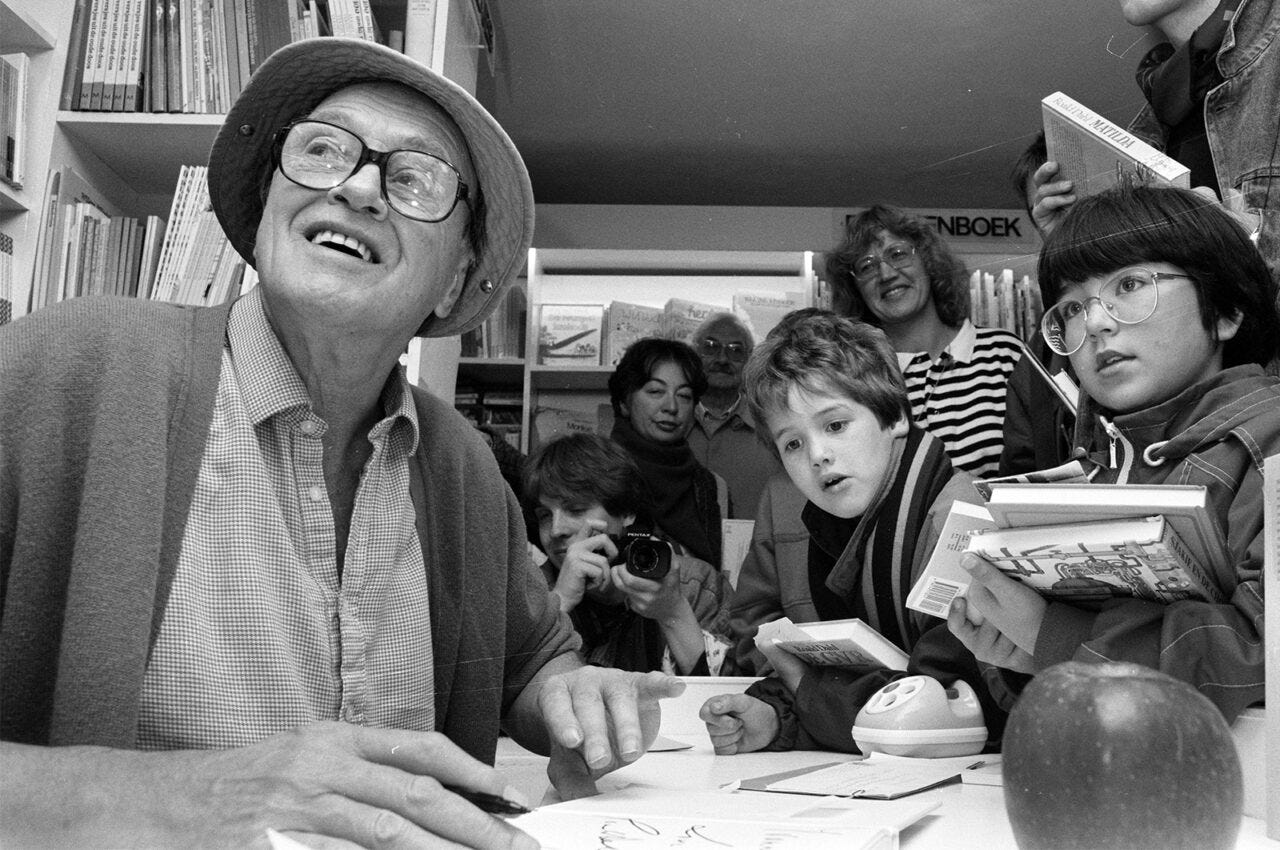
The discussion of whether we can separate the art from the artist is one that I’ve struggled with for a long, long time. Ever since I first read Animal Farm and 1984 in high school, I’ve counted George Orwell as a major influence on my thinking and my writing. In his earlier works, he was pretty disparaging of Jewish people. But in his later years, he wrote an essay, Antisemitism in Britain, in which he astutely urged intellectuals to examine their own susceptibility to hating Jews.
The point is that something, some psychological vitamin, is lacking in modern civilization, and as a result we are all more or less subject to this lunacy of believing that whole races or nations are mysteriously good or mysteriously evil. I defy any modern intellectual to look closely and honestly into his own mind without coming upon nationalistic loyalties and hatreds of one kind or another. It is the fact that he can feel the emotional tug of such things, and yet see them dispassionately for what they are, that gives him his status as an intellectual. It will be seen, therefore that the starting point for any investigation of antisemitism should not be ‘Why does this obviously irrational belief appeal to other people?’ but ‘Why does antisemitism appeal to me? What is there about it that I feel to be true?’ If one asks this question one at least discovers one’s own rationalizations, and it may be possible to find out what lies beneath them. 11
We all have biases and prejudices that we picked up from various sources in our lives, be it our families, our faith traditions, our political parties, and so on and so on.
But that doesn’t mean we have to stay that way. And it all starts with asking the questions Orwell posed of ourselves.
https://www.jta.org/2022/01/13/israel/invasive-species-protests-and-forest-fires-how-the-pastime-of-planting-a-tree-in-israel-became-controversial
https://www.thetimes.com/article/81dda59f-7e05-4311-9131-377ee53554f2
https://www.thetimes.com/article/81dda59f-7e05-4311-9131-377ee53554f2
Rosenblatt, Mark. Giant (NHB Modern Plays) (pp. 73-74). (Function). Kindle Edition.
Rosenblatt, Mark. Giant (NHB Modern Plays) (p. 82). (Function). Kindle Edition.
Rosenblatt, Mark. Giant (NHB Modern Plays) (pp. 88-89). (Function). Kindle Edition.
Rosenblatt, Mark. Giant (NHB Modern Plays) (p. 89). (Function). Kindle Edition.
https://blogs.timesofisrael.com/emigration-from-israel-reaches-new-heights/
Rosenblatt, Mark. Giant (NHB Modern Plays) (pp. 68-69). (Function). Kindle Edition.
https://www.newstatesman.com/archive/2021/10/from-the-ns-archive-tale-of-the-unexpected
https://www.orwellfoundation.com/the-orwell-foundation/orwell/essays-and-other-works/antisemitism-in-britain/
Thanks for the squirm!
Wonderful essay!